
Ping Pong Table Size
A regulation ping pong table is 9 feet long, 5 feet wide and 30 inches high (2.74 × 1.525 m, 76 cm high) — but the table is only part of the space you need. This page lists the official dimensions of the table, net and lines, then lets you enter your room size to see whether a full-size table fits for casual play, comfortable rallies or competition, with a scaled drawing of the layout.
- Free to use
- No sign-up
- Runs in your browser
Will a ping pong table fit in my room?
Ping Pong Room and Play Pack
Printable dimensioned table tennis table diagram, a scale room planner, a round-robin tournament sheet, match score sheets and a rules summary card.
- Dimensions sheet (PDF/XLSX)
- Room planner (PDF)
- Round robin (PDF/XLSX)
- Score sheets (PDF/DOCX/XLSX)
- Rules card (PDF/DOCX)
Formats: PDF, XLSX, DOCX. Instant download after payment (link valid 72 hours, up to 5 downloads). AI-assisted: the templates were drafted with AI help and reviewed and laid out before publishing.
$5.00 USD, one-time 5 files · about $1.00 each
- Instant download
- 7-day refund
- Secure checkout by Stripe
7-day money-back guarantee. Full refund within 7 days of purchase, even after you download.
Free sample: Table Tennis Dimensions (PDF, 94 KB)
Full refund within 7 days — see the refund policy and license.
Free printables
Single sheets you can print right now, no sign-up. The full pack adds every sheet in one download plus the editable files.
 Printable Ping Pong Table Size Chart
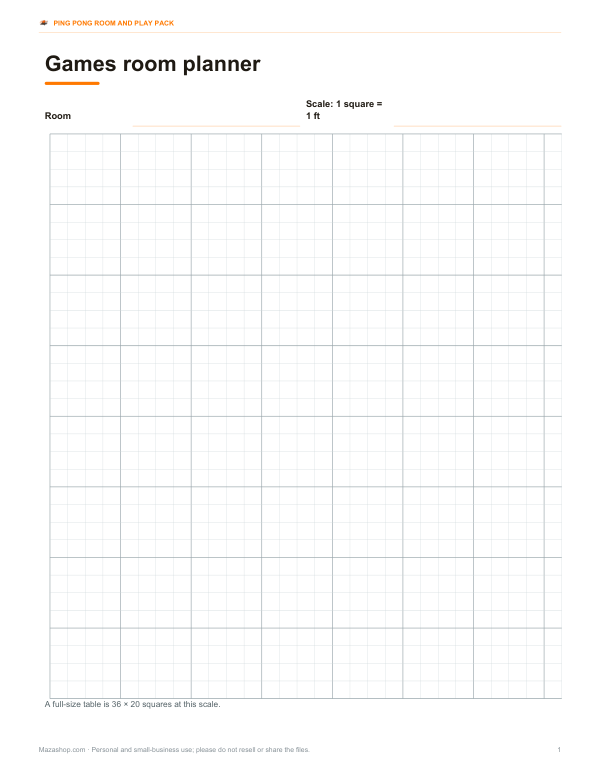 Printable Ping Pong Room Planner
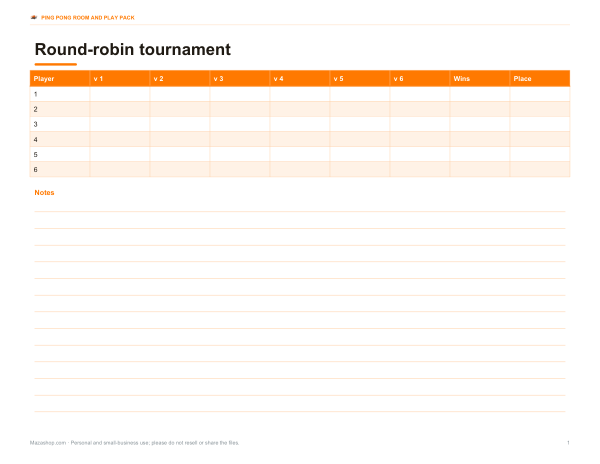 Printable Round Robin Tournament Sheet
 Printable Ping Pong Match Score Sheet
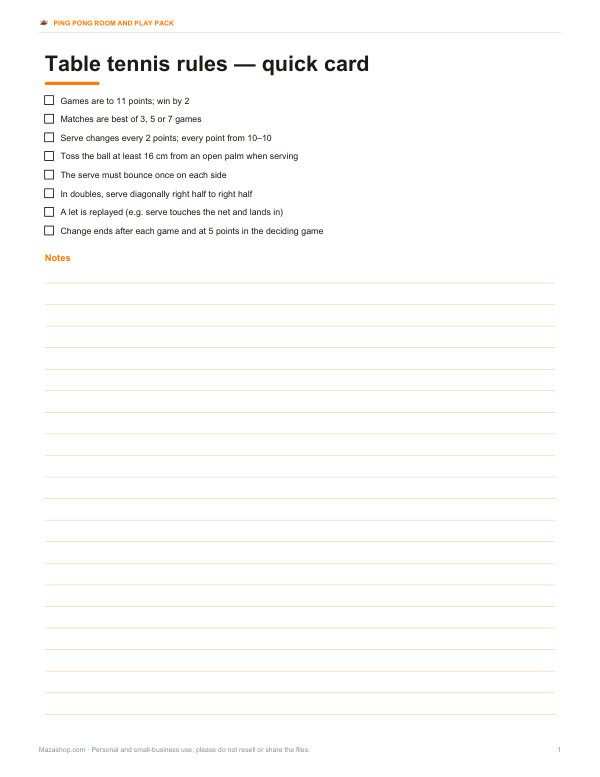 Printable Table Tennis Rules Card
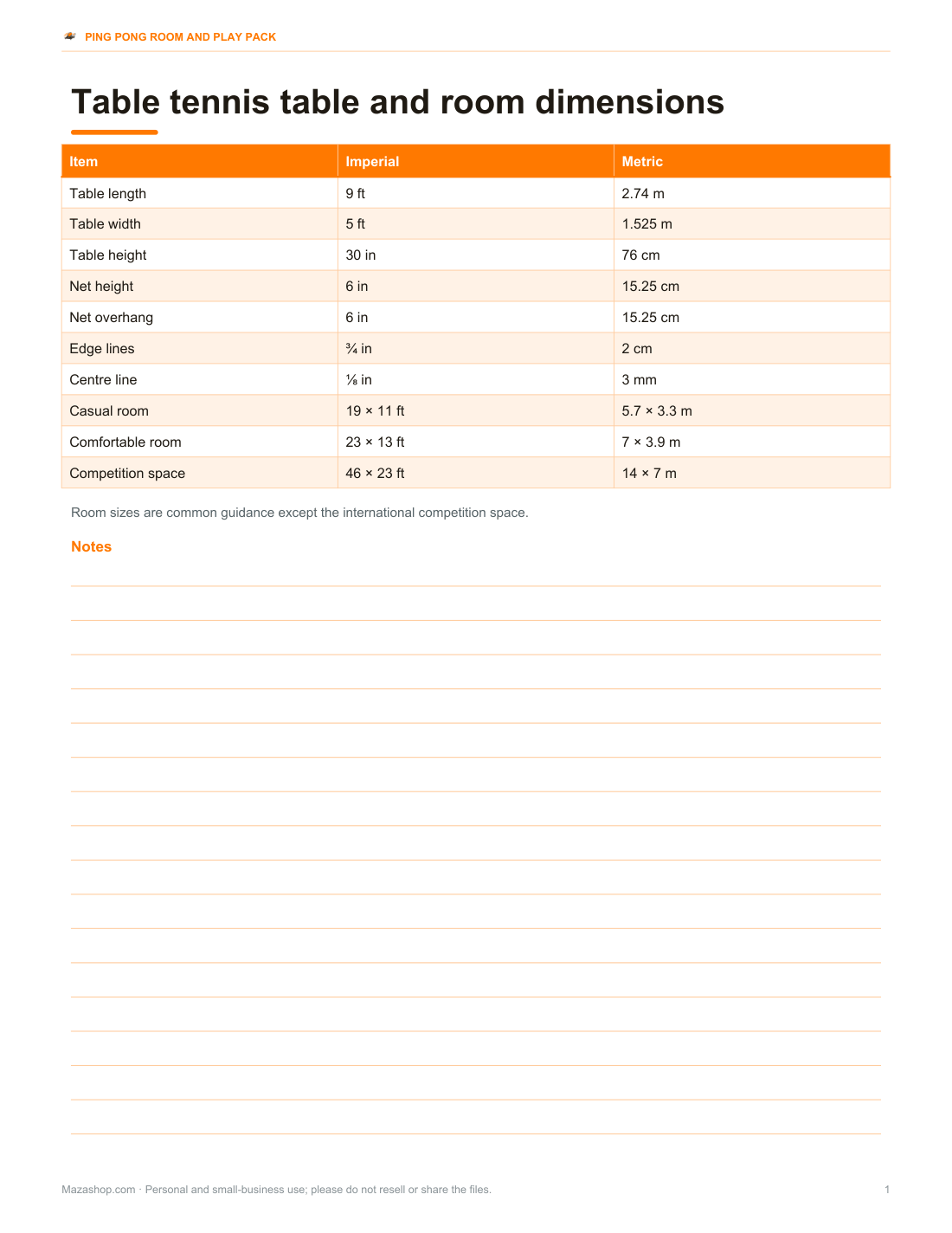
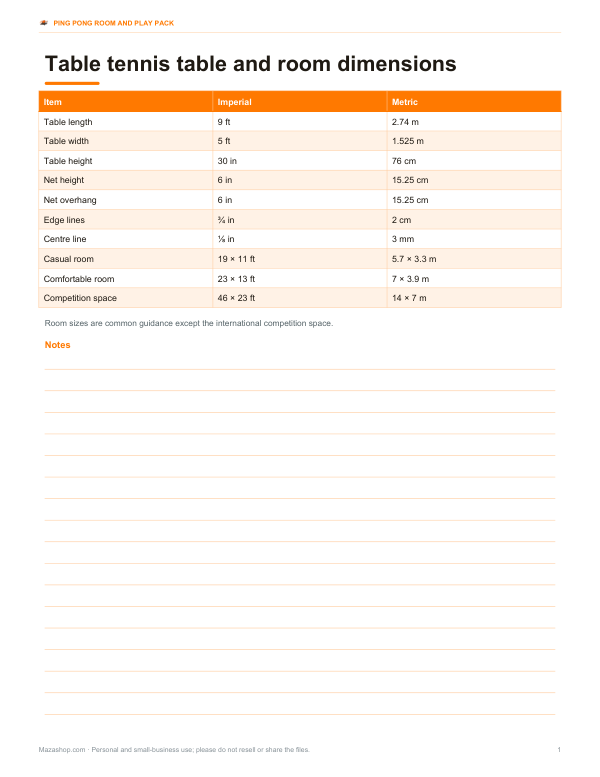
Official table tennis table dimensions
| Part | Imperial | Metric |
|---|---|---|
| Table length | 9 ft | 2.74 m |
| Table width | 5 ft | 1.525 m |
| Playing surface height | 30 in | 76 cm |
| Net height | 6 in | 15.25 cm |
| Net overhang beyond each side | 6 in | 15.25 cm |
| Total net length | 6 ft | 1.83 m |
| White edge lines | ¾ in | 2 cm |
| Centre line (for doubles) | ⅛ in | 3 mm |
These are the dimensions set by the international governing body for table tennis and used by national associations. The surface must be a uniform dark matt colour with a consistent bounce: a regulation ball dropped from 30 cm should bounce about 23 cm.
How much room do you need?
| Level | Space behind each end | Space each side | Room size (full table) |
|---|---|---|---|
| Tight, casual only | 4 ft (1.2 m) | 2.5 ft (0.75 m) | about 17 × 10 ft (5.1 × 3 m) |
| Casual play | 5 ft (1.5 m) | 3 ft (0.9 m) | about 19 × 11 ft (5.7 × 3.3 m) |
| Comfortable rallies | 7 ft (2.1 m) | 4 ft (1.2 m) | about 23 × 13 ft (7 × 3.9 m) |
| Club-style play | 10 ft (3 m) | 6 ft (1.8 m) | about 29 × 17 ft (8.7 × 5.1 m) |
| International competition | — | — | at least 14 × 7 m (46 × 23 ft) |
Beginners and children stand close to the table, so casual play needs less space; experienced players move back and to the side, so their game needs much more. Ceiling height matters too: lobs need at least about 8–9 feet, and competition halls require several metres.
Using the room checker
- Measure the room wall to wall and subtract anything that sticks out — radiators, sofas, a car in the garage.
- Enter the length and width in feet or metres.
- The checker places the table along the longer wall and shows the clearance at the ends and sides.
- The green dashed area shows the best play zone that fits.
- Use Custom size for mid-size or mini tables — their sizes vary by brand.
Worked example
A garage 20 ft long and 12 ft wide leaves (20 − 9) ÷ 2 = 5.5 feet behind each end and (12 − 5) ÷ 2 = 3.5 feet at each side. That meets the casual-play guideline of 5 ft and 3 ft, but not the comfortable-rallies level of 7 ft and 4 ft, which would need a room about 23 × 13 feet.
Lighting, floor and ceiling
Good, even lighting matters more than most people expect: the ball is small and fast, and shadows or glare from a window make it hard to track. Ceiling lights placed above and slightly to the sides of the table work better than a single bulb directly over the net. A non-slip floor helps — rubber mats or a wooden floor are better than smooth concrete — and walls in a darker, plain colour make a white ball easier to see. Allow for a ceiling of at least about 8 feet so that lobs and high serves don’t hit it.
Setting up the table
- Check the floor is level, or use the table’s adjustable feet.
- Unfold both halves and lock them; test that the joints are secure.
- Clamp the net at the centre so the top is 6 inches (15.25 cm) above the surface at every point.
- Check the net posts overhang the sides by 6 inches.
- Keep the table out of direct sunlight to stop warping and fading, and cover it when not in use.
Space for doubles
Doubles players need more room to the sides because partners take turns hitting and must move out of each other’s way. If you often play doubles, aim for at least the comfortable-rallies level, and ideally more width than the minimum shown by the checker.
Choosing a table for a small space
- A folding “playback” table lets one player practise alone with half the table raised.
- Outdoor tables are weatherproof but heavier; allow space for wheels and folding.
- Mid-size and mini tables need less room but play differently; they are great for children.
- Conversion tops sit on a pool or dining table — check the base is at least 30 inches high and stable.
- Leave room to walk past the folded table if it lives in a shared space.
Other equipment sizes
| Item | Official specification |
|---|---|
| Ball | 40 mm diameter, 2.7 g, white or orange |
| Racket blade | Any size or shape; at least 85% natural wood |
| Rubber | Approved rubber, red on one side and black (or another approved colour) on the other |
| Net assembly | Clamped to the table, top 15.25 cm above the surface |
Printable planning pack
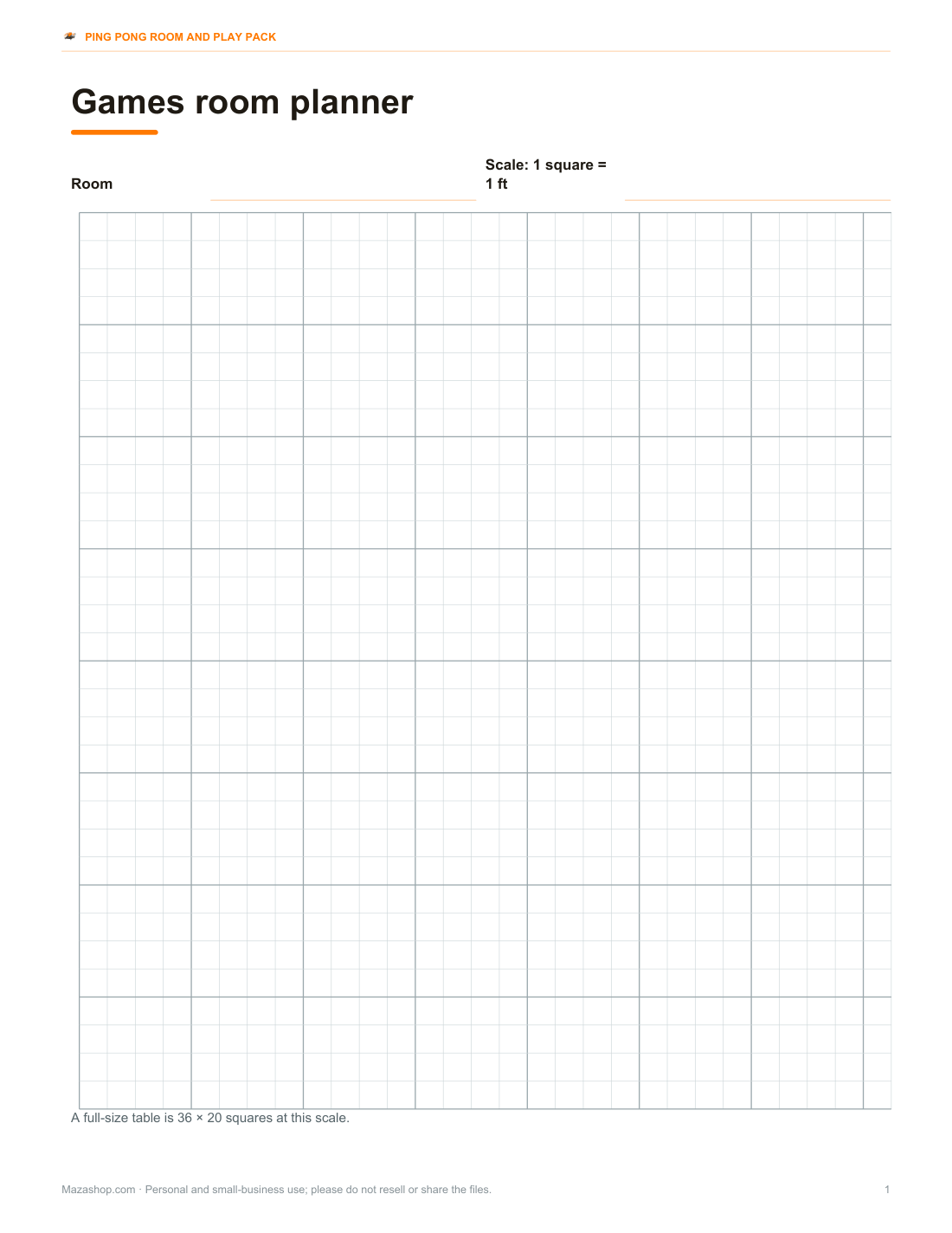
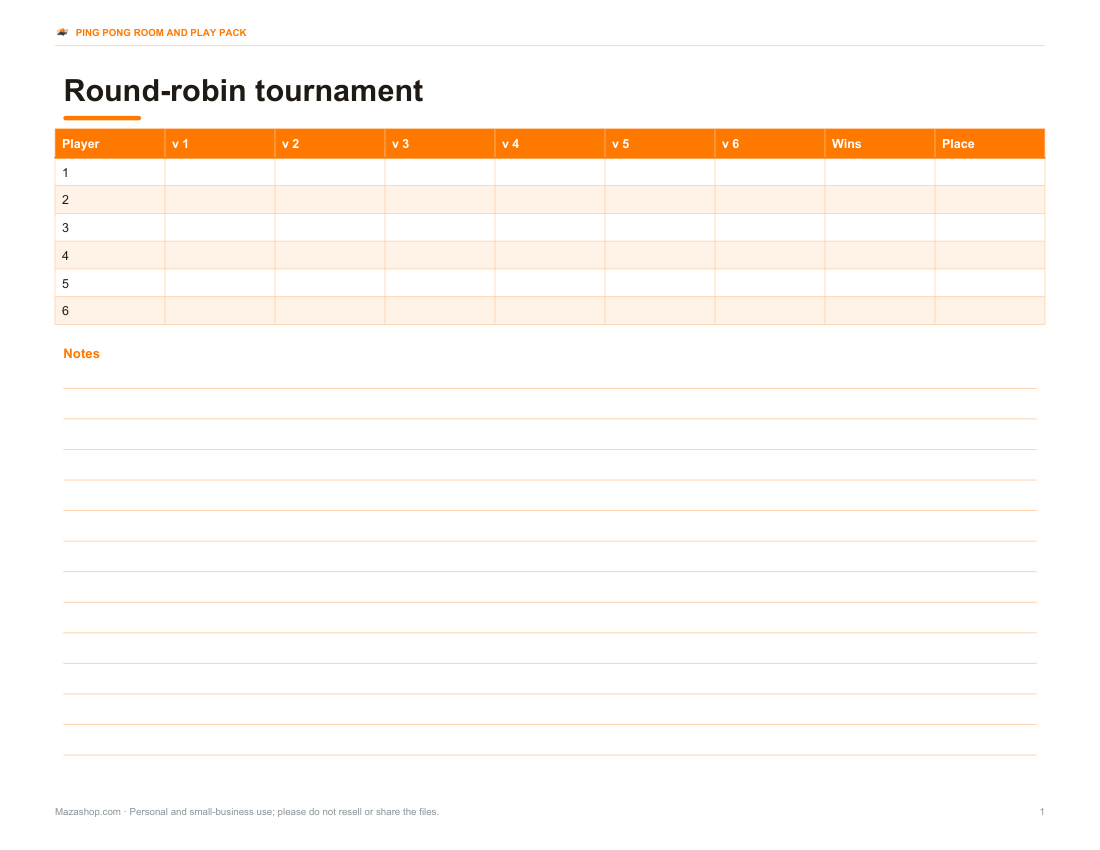
The optional pack includes a dimensioned table diagram, a scale room planner on graph paper, a round-robin tournament sheet, score sheets and a rules summary card. The room checker above is free to use.
AI-assisted content
Explanations were drafted with AI assistance and reviewed before publishing. Clearance levels are common guidance; check your club or league rules for competition requirements.
Frequently asked questions
What size is a regulation ping pong table?
9 ft × 5 ft (2.74 × 1.525 m) and 30 in (76 cm) high.
How high is a ping pong net?
6 inches (15.25 cm).
What size room do I need for a ping pong table?
About 19 × 11 ft for casual play, more for serious rallies.
Will a ping pong table fit in a one-car garage?
Often for casual play if the garage is clear and about 19–20 ft long and 11 ft wide.
How big is a ping pong ball?
40 mm in diameter.
How much space do I need behind the table?
At least about 5 feet (1.5 m) behind each end for casual play.
Is there a size rule for paddles?
No, the blade can be any size or shape.